
What Is Precast Concrete? A Complete Guide for Saudi Construction Projects
What Is Precast Concrete? A Complete Guide for Saudi Construction Projects
Introduction to Precast Concrete in Saudi Arabia
Saudi Arabia’s construction sector is undergoing a historic transformation. Driven by Saudi Vision 2030, the Kingdom is witnessing unprecedented investment in residential housing, commercial developments, industrial zones, transportation networks, and giga-projects such as NEOM, the Red Sea Project, Qiddiya, and major urban expansions across Riyadh, Jeddah, Dammam, and other cities.
Within this fast-paced environment, precast concrete has emerged as a preferred construction solution. Developers, contractors, and government stakeholders are increasingly turning to precast concrete construction to meet tight project timelines, achieve consistent quality, and ensure long-term durability in Saudi Arabia’s demanding climate.
The growing reliance on precast concrete in Saudi Arabia is not accidental. It aligns with the Kingdom’s focus on industrialized construction, sustainability, cost efficiency, and international quality standards. This guide provides a comprehensive, professional overview of precast concrete—what it is, how it is manufactured, its advantages, applications, and its strategic role in Saudi Arabia’s future construction landscape.
What Is Precast Concrete?
Precast concrete is a construction method in which concrete elements are manufactured in a controlled factory or plant environment, then transported to the project site for installation. Unlike traditional methods where concrete is poured and cured on-site, precast components are produced off-site under strict quality controls.
Key Characteristics of Precast Concrete
Manufactured in reusable molds
Produced under controlled temperature and curing conditions
Transported to site after achieving required strength
Installed using cranes and specialized lifting systems
How It Differs from Traditional Concrete
Traditional construction typically relies on cast-in-place (in-situ) concrete, where formwork, reinforcement, pouring, and curing all take place on-site. This process is heavily affected by weather, labor skill, and site conditions.
Precast concrete, by contrast, shifts much of the construction process to a factory setting, resulting in improved consistency, reduced site labor, and faster project completion.
How Precast Concrete Is Manufactured
Precast concrete manufacturing follows a standardized, quality-driven process designed to ensure structural integrity, dimensional accuracy, and long-term durability.
Step-by-Step Manufacturing Process
Design & Engineering
Structural design based on project specifications
Shop drawings and mold planning
Compliance with Saudi building codes and project standards
Mold Preparation
Steel or fiberglass molds cleaned and prepared
Release agents applied for smooth demolding
Dimensional checks performed
Reinforcement Placement
Steel rebars, welded wire mesh, or prestressing strands installed
Accurate positioning ensures load-bearing performance
Concrete Mixing
High-quality concrete mix designed for strength and durability
Controlled water-cement ratio
Admixtures used for heat resistance and workability
Concrete Casting
Concrete poured into molds
Vibration or compaction to remove air voids
Curing
Accelerated curing using steam or controlled temperature
Ensures early strength gain and uniform performance
Demolding & Finishing
Elements removed from molds after achieving target strength
Surface finishing, inserts, and connection details added
Quality Inspection & Testing
Dimensional checks
Strength testing
Visual inspection for defects
Storage & Transportation
Elements stored properly to avoid damage
Transported to site using specialized trailers
Types of Precast Concrete Products
Precast concrete is highly versatile and can be adapted to a wide range of structural and architectural needs.
Structural Elements
Beams
Columns
Precast slabs (solid, hollow-core, double-tee)
Load-bearing walls
Architectural Elements
Facade panels
Cladding panels
Decorative architectural features
Vertical Circulation
Precast stairs
Landings
Lift shafts
Infrastructure Components
Bridge girders
Culverts
Manholes
Drainage channels
Retaining walls
These products make precast concrete for infrastructure projects particularly valuable in Saudi Arabia’s expanding transportation and utilities sectors.
Precast Concrete vs Cast-in-Place Concrete
The decision between precast and in-situ concrete has significant implications for cost, quality, and project timelines.
Comparison Table
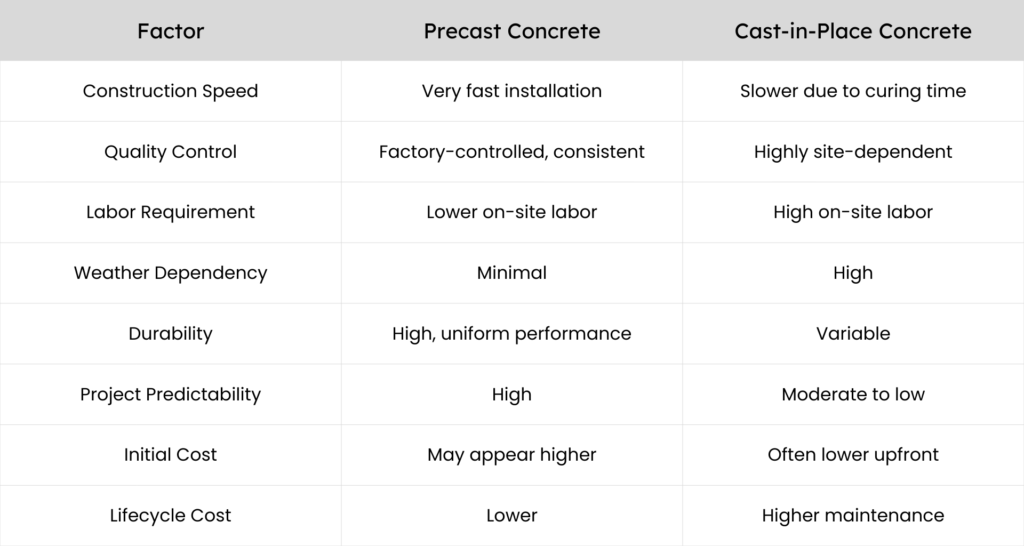
This comparison clearly highlights why precast vs cast in situ concrete is a critical consideration for modern Saudi projects.
Advantages of Precast Concrete for Saudi Construction Projects
The benefits of precast concrete align perfectly with Saudi Arabia’s construction needs.
Key Advantages
Speed of Construction
Parallel manufacturing and site work
Faster project delivery
Superior Quality Control
Factory conditions ensure consistent strength and finish
Reduced defects and rework
Cost Efficiency
Reduced labor costs
Less material waste
Lower long-term maintenance
Climate Suitability
Controlled curing avoids extreme heat effects
Optimized mix designs for Saudi conditions
Enhanced Safety
Reduced on-site activities
Safer working environment
These precast concrete advantages make it a strategic choice for both public and private sector projects.
Precast Concrete Performance in Saudi Arabia’s Climate
Saudi Arabia’s environment presents unique challenges, including:
Extreme heat
Large temperature fluctuations
High salinity in coastal areas
Sand and dust exposure
How Precast Concrete Performs
Heat Resistance
Optimized concrete mixes reduce thermal cracking
Controlled curing improves microstructure
Durability
Dense concrete reduces permeability
Better resistance to corrosion of reinforcement
Long-Term Performance
Reduced shrinkage and creep
Longer service life with minimal maintenance
As a result, precast concrete durability in hot climate conditions is superior to many traditional construction methods.
Applications of Precast Concrete in Saudi Arabia
Residential Projects
Apartment buildings
Villas and housing compounds
Affordable housing initiatives
Commercial Buildings
Office towers
Shopping malls
Hotels and mixed-use developments
Industrial Facilities
Warehouses
Factories
Logistics hubs
Infrastructure Projects
Bridges and flyovers
Metro and rail systems
Tunnels and drainage networks
Utility corridors
The flexibility of precast concrete for commercial buildings and infrastructure makes it indispensable in the Kingdom’s development plans.
Quality Standards & Compliance in Saudi Precast Manufacturing
High-quality precast production depends on strict adherence to standards.
Key Compliance Areas
Saudi Building Code (SBC)
Project-specific technical specifications
International standards (ASTM, BS, EN where applicable)
Quality Control Measures
Raw material testing
Concrete strength testing
Dimensional accuracy checks
Load testing when required
Continuous inspection throughout production
Adherence to precast concrete quality standards ensures safety, reliability, and regulatory approval.
Role of Precast Concrete in Saudi Vision 2030 Projects
Saudi Vision 2030 emphasizes:
Faster project delivery
Sustainable construction
Localization of manufacturing
Reduced reliance on foreign labor
Precast concrete supports these goals by:
Enabling industrialized construction
Reducing waste and environmental impact
Supporting large-scale, repeatable construction
Enhancing project predictability for mega-developments
For giga-projects, precast solutions are not optional—they are essential.
Cost Considerations of Precast Concrete in Saudi Arabia
Factors Affecting Cost
Design complexity
Volume of elements
Transportation distance
Crane and installation requirements
Project timeline
Long-Term Cost Benefits
Reduced construction time
Lower labor costs
Minimal rework
Reduced maintenance over lifecycle
When evaluated holistically, precast often delivers better value than traditional methods, despite higher initial unit costs.
How to Choose the Right Precast Concrete Manufacturer in Saudi Arabia
Selecting the right precast concrete supplier in Saudi Arabia is critical.
Key Selection Criteria
Proven experience in similar projects
Certified manufacturing facilities
Compliance with Saudi codes
Strong quality assurance systems
Adequate production capacity
Reliable logistics and installation support
A capable supplier becomes a long-term project partner, not just a material provider.
Common Challenges in Precast Concrete Construction (and Solutions)
Transportation Constraints
Solution: Early logistics planning and modular design.
Installation Coordination
Solution: Detailed erection sequencing and trained installation teams.
Design Integration
Solution: Early involvement of precast engineers during design stage.
Proper planning eliminates most precast-related challenges.
Future of Precast Concrete Industry in Saudi Arabia
The future of precast concrete in the Kingdom is strong.
Key Trends
Automation and robotics in precast plants
Digital design and BIM integration
Sustainable concrete mixes
Increased use in modular construction
Growing local manufacturing capacity
As Saudi Arabia continues its transformation, precast concrete will remain a cornerstone of efficient construction.
Conclusion
Precast concrete has become a cornerstone of Saudi Arabia’s modern construction ecosystem. Its proven speed of execution, consistent quality, long-term durability, and suitability for extreme climatic conditions make it an ideal solution for residential, commercial, industrial, and infrastructure developments across the Kingdom.
As Saudi Arabia advances toward the goals of Vision 2030, the adoption of precast construction is no longer just a technical preference—it is a strategic construction approach. Organizations that understand and effectively implement precast systems are better positioned to deliver projects that meet today’s demands for efficiency, reliability, and future readiness. Companies such as Alhosn Arabia, with deep industry knowledge and a strong focus on quality-driven construction solutions, reflect this forward-thinking approach.
For developers and stakeholders planning large-scale or time-sensitive projects, evaluating precast concrete solutions early in the project lifecycle can unlock significant technical, operational, and long-term economic advantages—ensuring projects are delivered with confidence, consistency, and lasting value.
FAQ: Precast Concrete in Saudi Arabia
Yes, precast systems are widely used in mid-rise and high-rise structures with proven structural performance.
Significantly. Manufacturing and site work occur in parallel.
Initial costs may be higher, but lifecycle costs are often lower.